
Most teams treat Facebook advertising design like a guessing game.
They come up with an idea, build the Facebook ad, push it live, and wait. When it doesn’t perform, they start from scratch. That cycle is slow, expensive, and hard to scale.
A better approach is building a system. Performance marketers call this a creative flywheel.
Let’s break down how that system works and what strong Facebook ad design looks like at each stage.
What is the Creative Flywheel?
The creative flywheel is a four-stage framework for running Facebook ads that convert consistently.
You source new concepts, launch and test them, analyze what’s performing, and iterate on your winners. Then you do it again.
The key shift here is thinking in concepts rather than individual creatives.
A concept is a distinct creative direction. It can be a specific angle, format, or message. A variant is that same concept with deliberate small changes. A duplicate is an exact copy launched into a new ad set to extend reach.
Meta’s algorithm now rewards creative diversity, so this distinction matters. Repeating the same ad leads to audience fatigue. Cycling through variations of proven concepts gives the algorithm stronger signals. In return, you get better data to work with.
Stage 1: Source your concepts
Every good creative starts before you open a design tool. Study what’s already working in your category first.
Start with competitor ads
The Meta Ad Library is free and shows you every ad any brand is actively running. Pull up your closest competitors, filter for active ads, and look for the ones that have been live the longest. An ad that’s been spending for six months or more is almost certainly earning its place in the rotation.
If you want to move faster, tools like Magic Brief pull competitor ads into one view, making it easier to spot patterns across multiple brands. Take note that you’re not looking for ads to copy. You’re looking for concepts that consistently generate results in your space, so you can build your own version.
If you’re a smaller brand, don’t benchmark against the category leaders. Find brands a tier or two above you. Their creatives will be far more relevant and actually replicable at your scale.
Choose your format strategically
Facebook ad formats break down into three broad categories. Static image ads work best for clear, direct messaging.
Clean and focused Facebook advertising design examples almost always outperforms cluttered creative. Carousel and collection formats are better when you need to show product range or walk users through a story. Video and Stories are where you go when the format itself needs to do the selling.
Glossier’s product ads are a strong benchmark for the Facebook video format. Their “Glossier You. Soie” launch ad shows how much a single frame can carry: a cinematic background, the product front and center, and barely a line of copy. The visual does the work.

Lead with your value proposition
The average Facebook user gives an ad about 1.7 seconds of attention. Your value proposition needs to land immediately: the offer, the pain point, or the clear outcome. Keep the copy short.
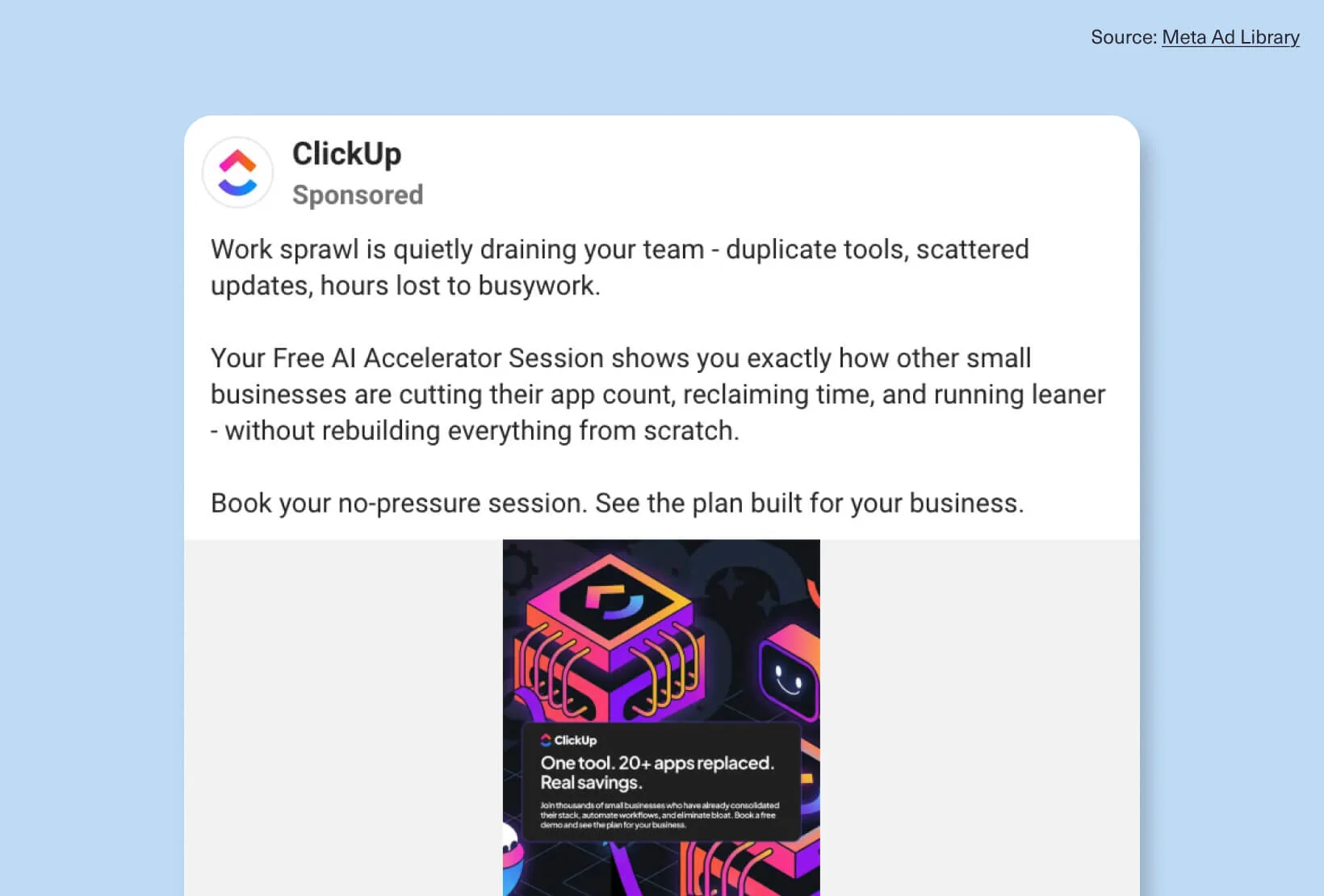
ClickUp leads with the cost of inaction before they mention the product. “Work sprawl is quietly draining your team” lands the pain in one line. The visual reinforces the payoff — “One tool. 20+ apps replaced. Real savings.” — and the CTA is a single, low-friction next step. Copy, creative, and offer all pulling in the same direction.
For more on the design principles behind high-converting ads and ideas for social media banners that drive engagement, both are worth a look.
Stage 2: Launch and test
Once your concepts are built, the priority is getting them real spend data quickly, without older ads consuming all the budget.
Use a prospecting CBO campaign
All new creative goes into a prospecting CBO (Campaign Budget Optimization) campaign. Each batch of ads gets its own ad set, usually four to eight creatives. As you keep testing, you’ll build up multiple ad sets from different rounds. That creates natural competition inside your account, which is exactly what you want.
Set ad set spending limits
The problem with CBO is that proven ads tend to absorb most of the budget, leaving newer concepts without enough spend to be evaluated fairly. The fix is setting a minimum daily spend on each new ad set equal to one times your target CPA. If your CPA goal is $50, the minimum is $50. This gives new creative a real shot at the data it needs.
After seven days, remove the limit. A winning creative will keep spending above that threshold on its own. One that isn’t working will fall back naturally. Either way, you get a clean answer without wasting unnecessary budget.
Reach the right audience
Facebook’s targeting lets you get specific with demographics, interests, behaviors, and location. The tighter the match between your ad and the people seeing it, the better your conversion rates will be. That said, don’t over-narrow at the ad set level. Carousel ads especially tend to work better when the algorithm has enough audience to match individual cards to individual users.
Make sure your landing pages match
A click is only the beginning. If the landing page feels different from the ad that sent someone there, most people will leave before they convert. The visual style, the offer, the headline — all of it should carry through from ad to page. Landing page design consistency and UX decisions that reduce friction are two of the most underrated conversion levers available to you.
Stage 3: Analyze performance
Seven days in, it’s time to let the data tell you what’s actually working.
Use incremental attribution
Go into your prospecting campaign, switch your column set to compare attribution settings, and select incremental attribution. This tells you which ads are generating conversions that wouldn’t have happened without them.
It’s a much sharper read than last-click attribution, which tends to give retargeting too much credit and prospecting too little.
Sort by highest spend to lowest. The ads worth your attention are the ones spending heavily and landing above your ROAS threshold. High spend plus above-target ROAS means a concept worth building on. Strong ROAS on low spend might just mean the ad hasn’t had enough budget to prove itself yet.
Look for patterns, not just performers
The goal of performance data and how it shapes better creative decisions goes beyond figuring out your best ad. It’s also understanding why it’s working. A top performer often signals something broader: a format your audience responds to, a message angle that resonates, a visual approach that earns attention. That’s what you carry into the next round.
Stage 4: Iterate and scale
This is where the flywheel comes full circle. You take what’s proven and build from it.
Know the difference between a concept, a variant, and a duplicate
A concept is the original idea. A variant makes meaningful changes to it. This can mean translating to a different copy angle, product, or format. A duplicate copies it exactly and places it in a new ad set or campaign. Variants teach you which parts of a concept are actually driving performance. Duplicates let you scale what’s already working into new audiences.
Facebook ad best practices have shifted here. The old move was to find your highest ROAS ad and put everything behind it. The smarter play now is running all your profitable concepts at the same time. A 2x ROAS concept spending heavily will contribute more to your bottom line than a 10x ROAS concept that can only support a small budget.
Stack concepts over time
The more consistently you run this process, the more proven concepts you’ll have in rotation. Some will scale. Others will stay lean but stay profitable. All of them add up. As your library grows, so does your creative baseline. And because each round of testing generates new data, each iteration is more informed than the last.
Keep testing
No creative runs forever. Audiences see the same ad enough times, engagement drops, and performance follows. Refreshing your creative every few weeks and keeping new concepts moving through your prospecting pipeline is what keeps results stable over the long run.
Facebook ad design is a system, not a single decision
How to design Facebook ads that convert consistently isn’t really a creative question. It’s a systems question. The flywheel gives you the structure: source, test, analyze, iterate. Do it consistently and your output compounds.
Strong Facebook ad design pays off at every stage in the quality of your concepts, in how your campaigns are structured, in how precisely you read the data, and in how quickly you build on what’s working.
If your team needs this kind of creative output at scale, Design Force handles social media ad design across static, carousel, and video formats, so your marketing team can stay focused on strategy. Book a call to talk through what your next campaign needs.