
Video is no longer fighting for a seat at the table.
According to Wyzowl’s 2026 report, 91% of businesses now use video marketing as part of their strategy. The question isn’t whether to invest in it. The question is whether your videos are actually working.
Find out the formats worth knowing, the trends shaping video content marketing, and the decisions that separate videos people actually watch from ones they scroll past.
Understanding Video Marketing
Video marketing spans more formats than most teams actively use. Here are the main categories.
- Long-form video
Think YouTube or Vimeo: documentaries, brand films, tutorials, or anything that runs over a minute.
When to use it: When your goal is to build a genuine connection with an audience or explain something with enough depth that a short clip won’t cut it. The average video ranking on YouTube’s first page runs close to 15 minutes, so if you’re going long, make sure the content earns the runtime.
- Short-form video
Short-form runs under 60 seconds. It lives primarily on social media but it also works well on websites and email campaigns. Its job is to deliver one clear idea quickly enough to share.
When to use it: When you need to reach someone fast and keep the message simple. Short-form video is the top format for ROI heading into 2026. Keep it tight and lead with your strongest point.
- Video advertising
Paid or organic, video ads are short-form content built for one thing: conversion. A sale, a sign-up, a demo booking.
When to use it: When you have a specific action you want your audience to take. They run across social platforms, websites, and email campaigns. Your hook needs to work in the first two to three seconds because you’re competing for attention against both content and other ads.
- Live video
Live streaming via YouTube, Twitch, TikTok, or LinkedIn puts you in front of an audience in real time, unscripted and unedited.
When to use it: When connection matters more than polish. Q&As, product launches, and behind-the-scenes content all work well here. Viewers tend to stay engaged longer with live content, and the raw quality often reads as more trustworthy than a produced video.
- YouTube Shorts and Instagram Reels
Vertical, native, short. These are the dominant formats on two of the biggest platforms right now. YouTube Shorts averages 200 billion daily views globally. Reels have become the default content format on Instagram.
When to use it: When social media video is a core part of your strategy. Both platforms actively reward content that feels native to the feed. Shoot vertically by default and treat repurposed horizontal clips as a last resort, not a workflow.
Video also spans multiple production styles. From traditional camera work to animation and motion graphics, or a mix of both, there’s a format to suit every kind of business and budget.
Incorporating video marketing into your campaigns
Before you produce anything, make sure you’re clear on two things: who you’re trying to reach, and what you want them to do after watching. Those answers determine what format and platform to use.
If you’re not sure where to start, here are content types that consistently perform across industries:
- Product demos and how-to tutorials
- Brand stories
- Founder or team Q&As
- Documentary-style or vlog content
- Customer testimonials
- Expert interviews
- Case studies
- User-generated content (UGC), repurposed with the creator’s consent. For brands targeting younger audiences, learning how Gen Z responds to video content is worth understanding.
- Collaborations with creators or partners
The case for video is strong. Here’s what the current data shows:
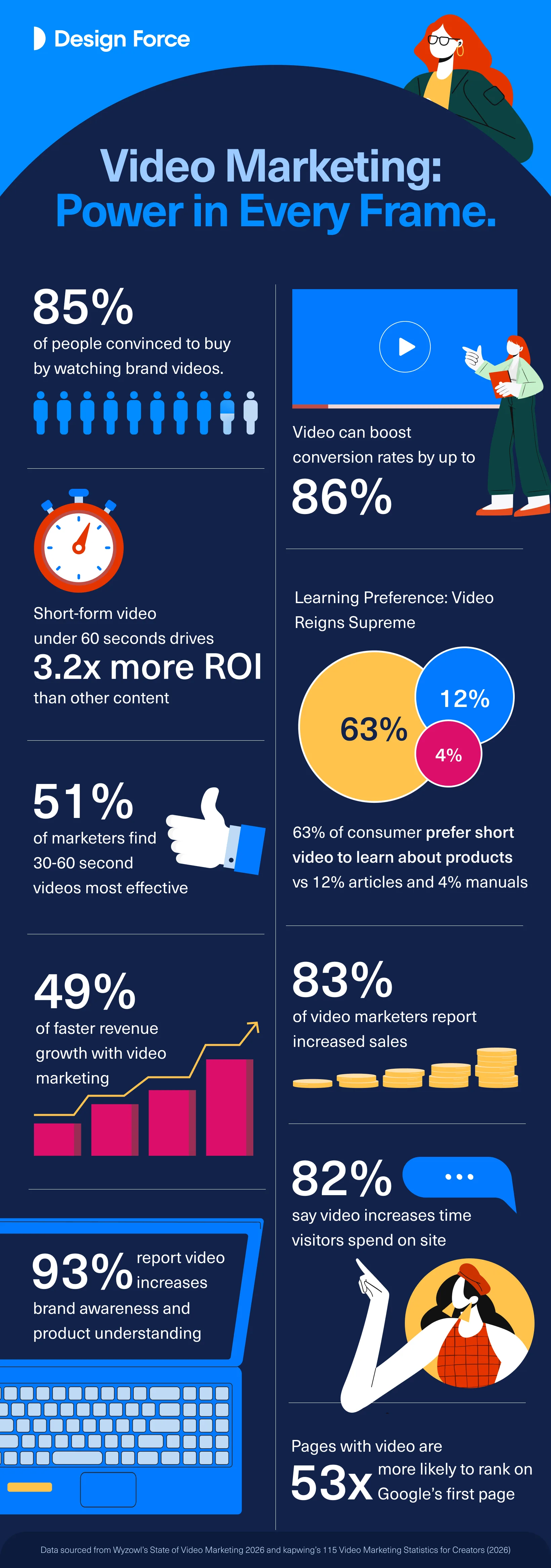
- Purchase Power: 85% of people have been convinced to buy a product or service by watching a brand’s video
- Landing Page Impact: Adding a video to a landing page can boost conversion rates by up to 86%
- ROI Leader: Short-form video (under 60 seconds) is the #1 format for ROI, driving 3.2x more return on investment than other content types
- Learning Preference: 63% of consumers say they would most like to watch a short video to learn about a product, compared to just 12% who prefer articles and 4% who prefer manuals
- The “Sweet Spot” for Length: 51% of marketers find that videos between 30 and 60 seconds are the most effective length for engagement
- Direct Sales Growth: 83% of video marketers report that video has directly increased sales for their business
- Revenue Acceleration: Organizations using video marketing see 49% faster revenue growth compared to organizations that do not use video
- Website Dwell Time: 82% of marketers say video has helped increase “dwell time,” keeping visitors on their website longer
- Brand Authority: 93% of marketers report that video has successfully increased both brand awareness and user understanding of their products or services
- Search Visibility: Pages featuring video are 53 times more likely to rank on the first page of Google search results
Data sourced from Wyzowl’s State of Video Marketing 2026 and Kapwing’s 115 Video Marketing Statistics for Creators (2026)
Why does video perform so consistently? Moving images hold attention longer than static content, which means platforms favor them algorithmically and push them to more viewers.
Beyond social, video works across the full marketing stack. When done right, a welcome video on your homepage or a product demo on a landing page can bring in more engagement compared to copy and visuals.
Design Force tip ✨
Start with one 15-second vertical video per week for social. Pick one clear idea, shoot it, and review the analytics after two weeks. Repeat what works. You’ll learn more from two weeks of real data than from three months of planning.
Video marketing trends to know in 2026
The landscape has shifted considerably in the last couple of years. Here’s what’s actually driving results now.
- AI is accelerating production but not replacing judgment
AI is reshaping creative workflows. AI video tools crossed $700 million in market value in 2025, and adoption is moving fast. Around 75% of marketing videos in 2026 are expected to be AI-generated or AI-assisted.
Teams are using AI for scripting, captioning, automated editing, and rough-cut generation, and it’s genuinely reducing production timelines.
The flip side? AI-generated content is now everywhere, and audiences are noticing. The brands seeing the strongest engagement in 2026 are the ones using AI for repetitive work while keeping human presence and storytelling at the center.
- Authenticity is outperforming production value
Consumers are increasingly drawn to content that feels real. UGC-style video, founder-led content, and raw behind-the-scenes clips regularly outperform expensive studio productions on social platforms.
This is good news if you’re working with a lean budget. Visual storytelling doesn’t require a big crew. It requires a clear point of view and something worth saying.
- Short-form vertical video dominates attention
YouTube Shorts, Instagram Reels, and TikTok are where attention is concentrated right now. The algorithms on each platform favor native vertical content over repurposed horizontal clips.
If you’re producing video primarily for desktop or broadcast and then cropping it for social, you’re working against the format. Shoot vertical by default for social placements and let the platform do the rest.
Don’t limit your videos to YouTube Shorts, Instagram Reels, and TikTok. X can also play an important role in your distribution strategy, especially for educational content, interviews, podcasts, and product demos.
Repurposing long-form YouTube videos into engaging X posts helps extend your content’s reach and gives each upload a longer lifespan. Check how to repurpose YouTube videos as X posts with AI.
- Video SEO is no longer optional
In search, Google surfaces video results prominently. That makes video SEO a real ranking lever, not just a nice-to-have. Optimized titles, keyword-rich descriptions, captions, and proper metadata all contribute to how and where your videos surface in search.
Captions in particular do double duty: They improve accessibility and provide search engines more text to index.
- Sound-off is the default
Half of all video viewers watch without sound. That means your video needs to communicate clearly in silence. This can be through on-screen text, captions, and visuals.
This is especially important for social media design: if the caption disappears and the visual alone doesn’t communicate the point, the ad or post isn’t finished yet.
Video marketing tips for creating content that works
Ready to produce? Here’s what makes people watch or scroll past.
- Hook in the first three seconds
Your opening is the most important creative decision you’ll make. Lead with the tension, the payoff, or a visual that stops the scroll. Save the logo and the brand intro for later, or cut them entirely.
- Build around one idea
Pick the single most important point you want your audience to walk away with, and build the entire script around that. If something doesn’t serve that point, cut it.
- Make the visuals earn the watch
Attention spans are short, and motion alone isn’t enough to keep people watching. On-brand colors, readable typography, and intentional camera choices are crucial factors. Consistent visual design across your social content also builds recognition over time.
- Design for silent viewing
Captions are no longer optional. Remember, half of your viewers are watching without sound, and captions also improve your video’s SEO by giving search engines more text to work with. Keep on-screen text short and readable at mobile size.
- End with a clear next step
One clear call to action, not three. Tell people what you want them to do once the video ends. Buy, subscribe, book a call, visit a page. If you give viewers too many options, most will choose none of them.
Final thoughts
The brands who are successful in video marketing in 2026 are producing consistently, testing what works, and building on it.
As your output scales, the challenging part is how to maintain quality and brand consistency across formats and platforms. That’s where outsourcing social media design and video production can give your team the creative capacity to keep pace.