Five steps to find the right creative partner without wasting budget or slowing execution.
Marketing teams are producing more creative assets than ever, across more channels, at faster turnaround times. Hiring in-house designers can’t always keep pace, and freelancers (however talented) come with coordination overhead that quietly eats into your week.
On-demand design teams have become the practical middle ground: flexible, scalable marketing design support without the cost or commitment of full-time headcount.
Next time you’re wondering how to hire an on-demand design team, use this five-step framework to choose the right partner and skip the expensive trial and error.
What is an on-demand design team?
An on-demand design team is an external creative resource you access through a subscription, retainer, or project-based engagement. Think of it as a dedicated design team that’s yours when you need it, without the HR paperwork.
Typical output covers the full range of creative services for marketers: ad creative, landing pages, social graphics, presentation design, email templates, and motion graphics.
The key advantage is scalable design resources without the overhead, giving you senior design capacity when your campaign calendar is full, and no dead cost when it isn’t.
When does it make sense?
An outsourced design team works well when your creative volume is consistent and growing.
Signs you’re ready:
- Frequent creative requests that are outpacing internal capacity
- Multiple active marketing channels each requiring adapted assets
- Campaign cycles moving faster than your current production can support
- Slow internal turnaround creating bottlenecks for your wider team
Worth being honest about the limits, too. A design-as-a-service model isn’t the right fit for one-off projects or major brand transformations, where deeper strategic involvement is usually what’s needed.
The five-step framework for hiring an on-demand design team
1. Audit your design needs
Before approaching any provider, get clear on your own requirements.
Use the Marketing Design Capacity Score as your starting point: monthly request volume multiplied by average asset complexity (low, medium, high). Social graphic would be low complexity, as an example.
Design Capacity = Monthly Requests x Average Complexity
- Low score:
freelancer - Mid score:
on-demand design team - High score:
dedicated multi-discipline team
This 5-minute task can help determine whether a design subscription service makes sense for your goals.
Don’t skip this step, it’s the one that saves you from signing up for the wrong tier and realising three weeks in.
2. Compare your options
The design agency vs freelancer debate now has a third answer.
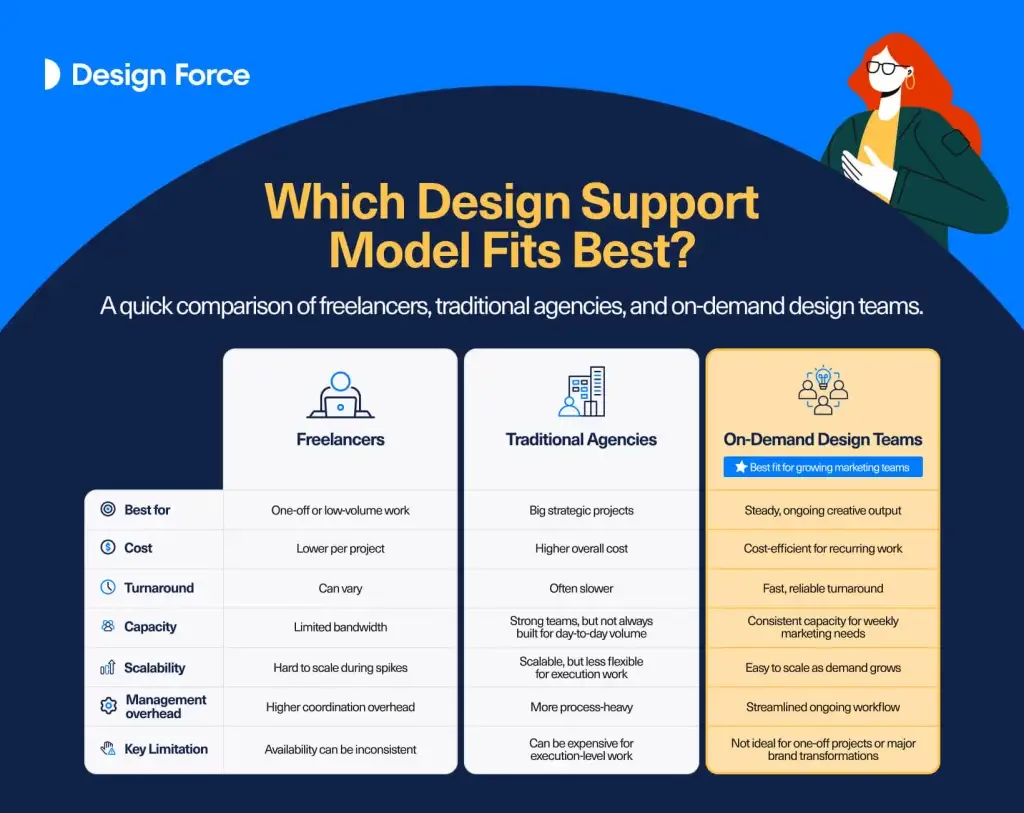
Here’s how the models stack up:
- Freelancers:
Lower cost per project, but limited bandwidth, variable availability, and no cover when volume spikes - Traditional agencies:
Strong strategic capability, but slower turnaround and higher cost for execution-level work - On-demand design teams:
Consistent capacity, faster turnaround, and built for the volume and variety that marketing teams generate week to week
Here’s a visual guide to compare the top-used design model when it comes to outsourcing creative work.
3. Review portfolio relevance
A strong portfolio is only useful if it reflects your reality. Look for marketing-focused work that matches your industry, asset types, and production volume.
A team that does beautiful brand identity work isn’t always the right call for a demand generation team running 20 ad variants a week. Find examples that look like your actual briefs.
4. Run a paid trial project
This is the step most people skip and later regret: Run a small paid test project before committing. Evaluate how the team interprets the brief, how quickly they respond to feedback, how the revision process works in practice, and whether the output needs significant rework.
Give your trial project a tight deadline that reflects your real working conditions. A team that performs well under low pressure but struggles at pace isn’t the partner you need.
5. Assess long-term scalability
Your design needs today won’t look the same in six months. Ask whether the team can handle growing volume, cover multiple design disciplines, and provide a dedicated point of contact.
Single-designer dependency is a real risk: if one person is unavailable, your production shouldn’t stall with them.
Red flags to watch for
Most problems with outsourced design teams are visible before you sign.
Watch for these:
- No clear turnaround commitments
in the contract or proposal - Generic portfolio
with no marketing-specific or industry-relevant work - Vague revision process
with no defined rounds or clear ownership - Single designer on your account
with no team backup - No marketing experience
in the team’s stated background
Any one of these creates bottlenecks once execution starts. Spot them early.
Questions to ask before signing
- What’s your standard turnaround time for common asset types?
- Who specifically works on our account, and what’s their background?
- How are revisions handled, and how many rounds are included?
- What happens during high-volume periods or tight deadlines?
- What marketing assets do you produce most often?
Quick hiring checklist
Before committing to any hire graphic designers on demand arrangement, make sure you can tick every box:
- Defined monthly design volume and asset types
- Portfolio with relevant marketing and industry examples
- Clear turnaround commitments in writing
- Transparent revision and feedback process
- Scalable capacity beyond a single designer
- Transparent pricing with no hidden scope creep
- Successful paid trial project completed
Choose fit over price
The best on-demand design team isn’t the cheapest or the largest. It’s the partner whose process, responsiveness, and creative experience align with how your marketing team actually works.
Start small, measure the output against your real briefs, and scale from there. The teams that get this right stop thinking about design capacity and start thinking about what to do with it.
Looking for consistent design support that keeps your brand moving? Connect with Design Force to explore how our dedicated design subscription could support your team, no pressure and no commitment.