

Marketing teams can move faster than ever. But getting that creative from first draft to final delivery is another story.
An asset can be produced in hours, then spend days waiting on feedback, revisions, brand review, or final approval. That gap is the creative production bottleneck, and most teams look for it in the wrong place.
Knak’s 2026 research found the most cited reason campaigns miss their launch dates is approvals, not creative production.
This article covers where bottlenecks actually form, how to find the one slowing your team, and what to change so more finished work reaches market.
What is a creative production bottleneck?
Your campaign brief is approved. The designers have started producing assets, and the launch date looks achievable.
Then feedback comes in from three stakeholders. Copy changes arrive after the first designs are done. Final approval sits in someone’s inbox for two days. Suddenly, a campaign that seemed on track is running behind.
That’s a creative production bottleneck: a stage in your marketing workflow where work arrives faster than the team can turn it into finished, approved, production-ready assets.
It’s different from a broader creative bottleneck, which can happen during ideation or concept development. A production bottleneck happens when something slows your team’s ability to turn creative work into finished, approved assets that are ready for market.
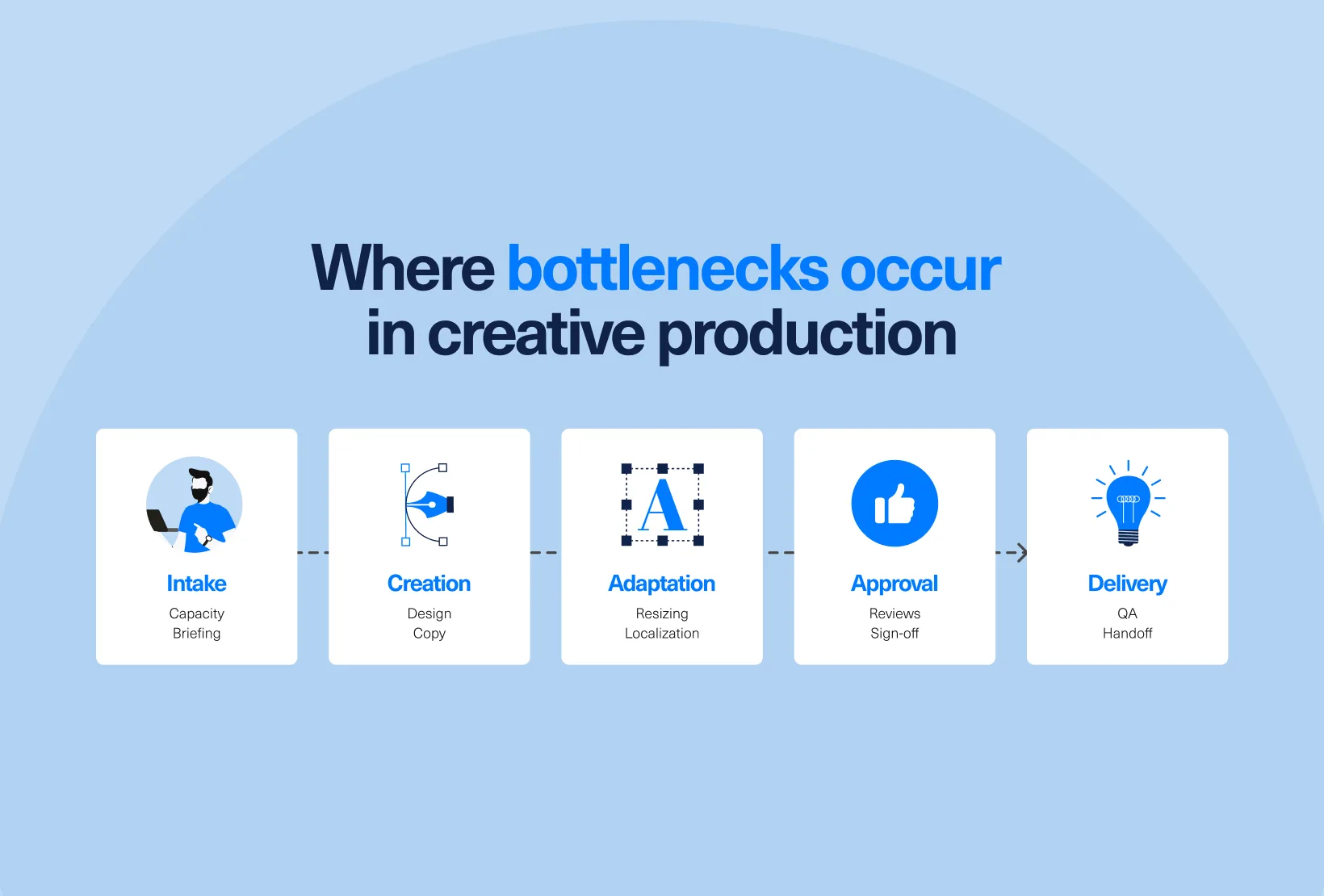
Even well-staffed teams experience production bottlenecks. Adding another designer to your in-house team won’t fix an unclear brief, a late approval, or repeated revisions.
Where the bottleneck actually sits
This finding should change how you think about creative production challenges.
Knak’s 2026 research found that 85% of marketing teams missed at least one campaign launch date in the past 12 months because of workflow constraints. The most cited cause? Approvals.
Knak surveyed 333 marketing decision-makers at organizations with $50 million to more than $1 billion in annual revenue. Among respondents whose campaigns missed launch dates, other common challenges included:
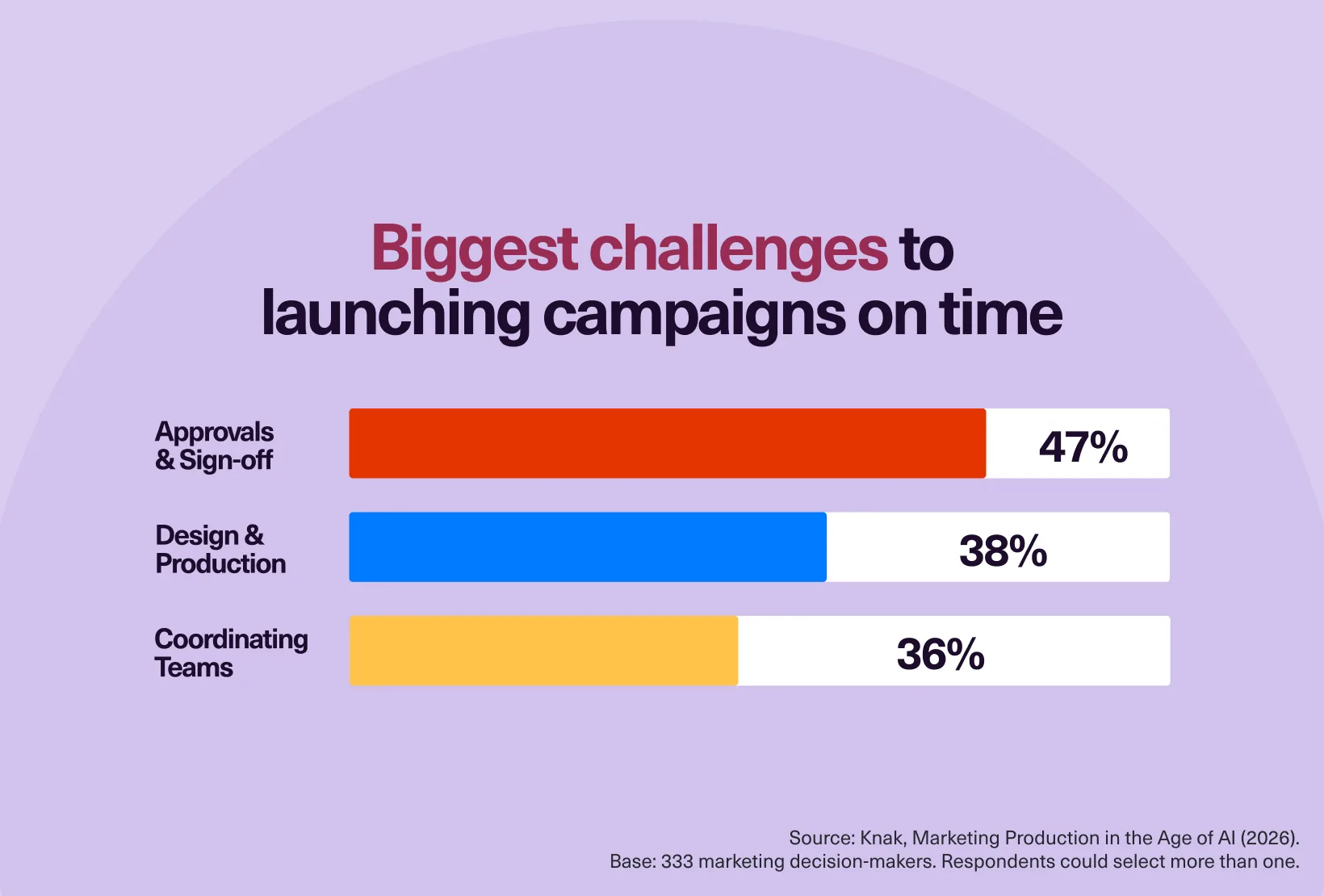
Approvals are part of production. They have a queue, an owner, and a limit on how quickly work can move through them. Coordination works the same way. A finished asset sitting in someone’s inbox is still unfinished from the campaign’s perspective.
For some marketing teams, adding creative production capacity alone won’t solve the problem. The limiting factor may sit before or after the creative work itself.
Why the usual fixes don’t work
When output slows, most teams reach for one of four moves. Each addresses a symptom while leaving the workflow untouched, so the creative production bottleneck tends to return.
Hiring more people
Recruiting and onboarding take months and carry permanent cost. More importantly, new hires inherit the existing workflow. They join the same approval chain, receive the same briefs, and wait on the same stakeholders. The workload spreads across more people for a while, then the constraint reasserts itself at whatever stage was actually limiting throughput.
Adding headcount doesn’t flex. Demand arrives in spikes, but salary is a fixed monthly commitment whether this month is a launch month or a quiet one.
Adding agencies or freelancers
Outsourcing moves production work outside the team without shortening the approval chain, so the stage most responsible for missed launches remains untouched.
A second cost shows up quietly. Every new external partner needs the brand explained, the guidelines shared, the preferences learned, and the past decisions re-litigated. Teams that rotate through freelancers rebuild that context with every engagement, and the time spent briefing an outside partner can exceed the time it would have taken internally.
Buying more software
New platforms bring their own workflows, permissions, and training requirements, and they rarely remove the operational problem that created the bottleneck.
Knak found that 54% of teams already use three to five separate tools to produce a single marketing email. Each tool boundary is a handoff, a place where work is exported from one system and imported into another, and a place where context or a version can be lost. A sixth tool adds a sixth boundary.
Adding AI
AI has reduced the time needed for some production tasks. Concept exploration, image variation, mockup visualization, retouching, and repetitive adaptation are all faster than they were years ago.
The gap between adoption and integration is widening. Knak found 70% of marketing teams have deployed AI, while only 29% describe advanced adoption with AI embedded across the entire workflow.
The Content Marketing Institute’s 2026 research, based on 1,015 B2B marketers, found 95% use AI applications somewhere in their workflow, while fewer than four in ten said it measurably improved performance.
Layering a faster generator onto an unchanged review and approval process produces more work arriving at the same queue. We come back to this in more detail below.
The pattern across all four? They add resources to a system without changing how work moves through it.
How to find your actual creative workflow bottleneck
To start, pull five to 10 recent creative requests. Include a few that went smoothly and at least two that didn’t. Then trace your design workflow from brief to delivery.
Where did the work wait?
Separate active working time from waiting time.
An asset might require only a few hours of design but take several days to wait for copy, consolidated feedback, or final approval. If that happens regularly, asking designers to work faster won’t solve much.
How many people touched it?
Count everyone who briefed, created, reviewed, commented on, approved, or delivered the work.
Knak found that 60% of surveyed teams had at least four people involved in producing a single marketing email.
Having several people involved isn’t necessarily the problem. Unclear roles are.
Every unnecessary handoff creates another opportunity for work to wait, feedback to conflict, or context to get lost.
Where did revisions come from?
The source of a revision is usually more useful than the number of revisions.
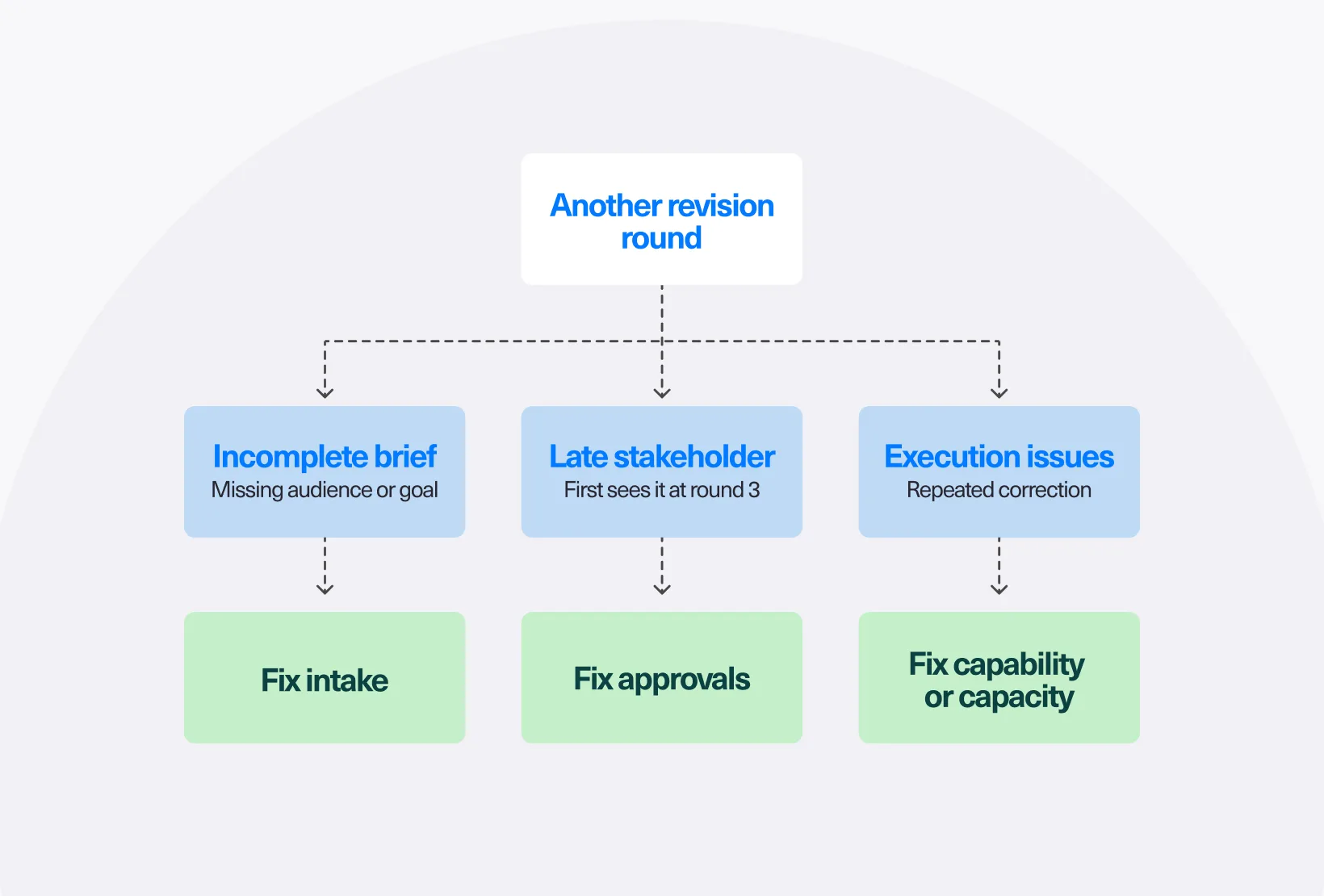
All three can show up as another revision, but they need different fixes.
How many revision rounds were there?
Knak found that 69% of surveyed teams typically go through two to three revision rounds before approval.
If your projects regularly exceed that, learn what’s causing the extra rounds instead of treating them as an unavoidable part of creative production.
Which work consumed senior time it didn’t need?
Resizing, versioning, reformatting, and rebuilding predictable assets often land on senior creatives because they know the brand well enough to work unsupervised. That work needs their hours and almost none of their expertise.
What share of time went to production versus strategy?
Knak’s respondents split their time 82% production, 18% strategy. If your team is close to that, the question isn’t whether people are working hard enough. It’s which stage is consuming the hours.
AI belongs in this conversation as one factor among several. It has changed the shape of the bottleneck without removing it, and understanding how is useful for deciding where to apply it.
Why creative production has become harder
Demand has grown faster than production capacity.
Marketing teams need more creative than they used to, across more channels and formats. A single campaign direction can quickly multiply into dozens of assets tailored to different platforms, audiences, and markets.
But creative production capacity isn’t just a question of how many designers are available. Every stage has a limit. Reviewers can only review so much. Decision-makers can only approve so much. Production teams can only adapt and QA so many versions at once.
AI has increased the amount of work teams can generate without necessarily increasing the capacity of everything that comes afterward.
The result is a marketing production bottleneck that looks like a design backlog, even when the real problem is happening elsewhere in the process. Mistaking the problem for a marketing creative bottleneck can lead teams to add creative resources without fixing what’s actually delaying their campaigns.
Where AI helps, and where it doesn’t
AI can speed up concept exploration, image variation, mockup visualization, retouching, and some repetitive adaptation work.
What it doesn’t do automatically is improve the entire production system.
Knak found that while 70% of surveyed marketing teams had deployed AI, only 29% described their adoption as advanced, with AI embedded across the workflow.
Research from the Content Marketing Institute points to a similar gap among B2B marketers. Its 2026 study found that 95% use AI applications somewhere in their workflow, while fewer than four in ten say it is measurably improving performance.
Using AI and building a production process around AI are different things.
An individual designer can use an image-generation tool. A marketer can draft copy with an LLM. A team can create variations that used to take hours.
Building AI into production requires more. Teams need to decide:
- Where it belongs
- What context it needs
- Who directs it
- How its output is refined
- What quality checks apply
- How that work moves through the rest of the workflow
Many teams have made generation easier without changing what happens after generation. That’s where the bottleneck often moves.
AI can generate an asset. Production makes it ready to use.
Knak found that 88% of respondents said AI-generated marketing content required moderate or substantial editing before use. 57% reported moderate editing, while 31% reported substantial editing.
That’s the difference between generating an output and producing something a brand can actually use.
For visual creative, AI-generated work may still require:
- Creative direction
- Brand alignment
- Typography adjustments
- Composition changes
- Retouching
- Copy refinement
- Correct dimensions
- Channel adaptations
- Localization
- Stakeholder review
- Revisions
- QA
- Export and delivery
AI-generated assets can look polished and arrive quickly, but they still need human judgment to ensure they’re accurate, on-brand, and right for the campaign. Generation creates the raw material; production applies that judgment to turn it into finished creative that’s ready to use.
AI can move the creative bottleneck downstream
Before generative AI, a team might have explored three concepts and turned the approved direction into 10 assets.
Now that team might explore 15 concepts and generate 60 variations in the same amount of time.
That gives teams more room to explore and test ideas that might have been impractical before.
But it also creates more decisions.
Someone still has to choose:
- Identify which concepts move forward
- Identify which variations fit the brand
- Decide what needs refinement
- Manage reviews
- Adapt the selected assets
- Handle legal or regional approvals
- Check everything before launch
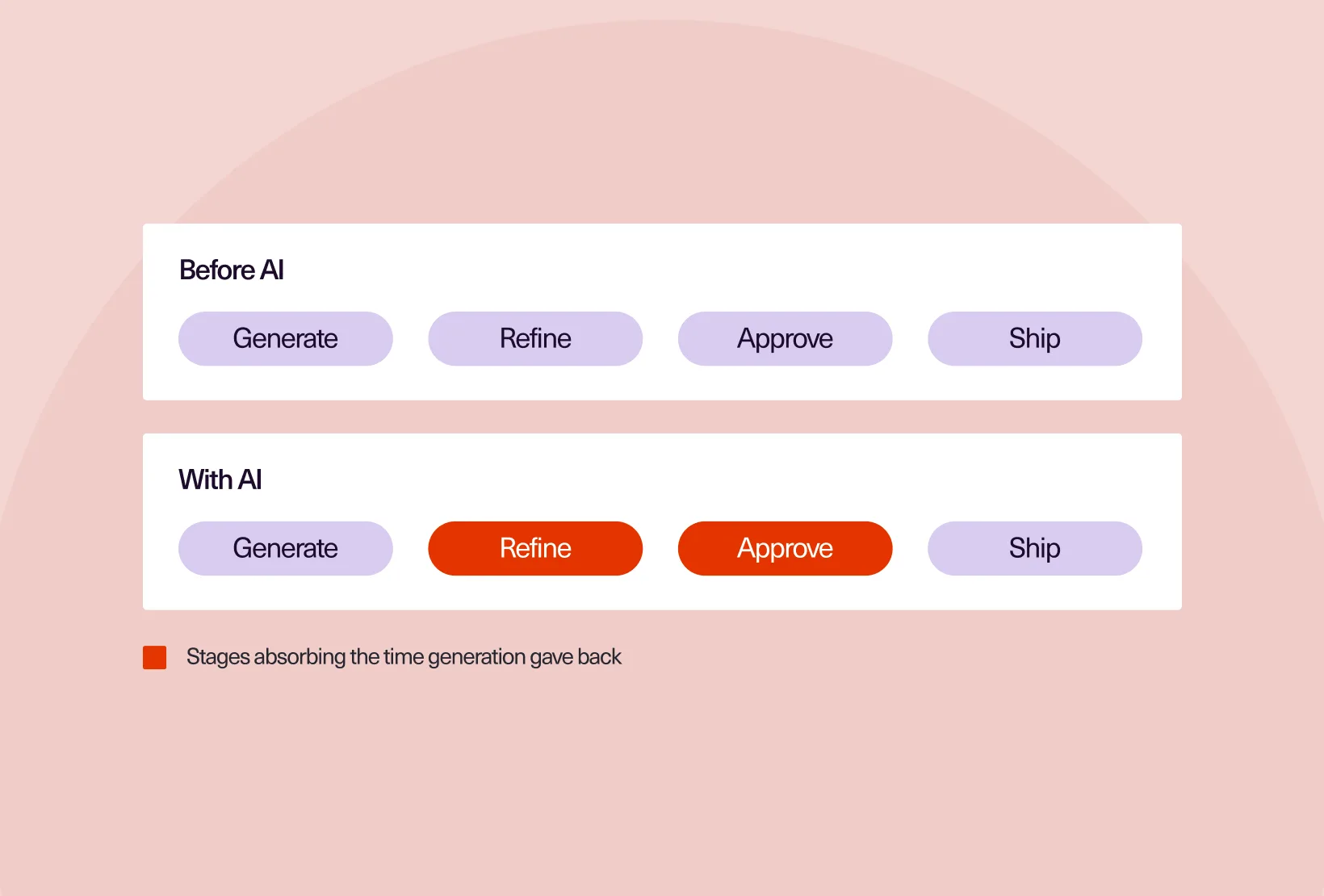
Generation gets faster and refinement backs up. Refinement improves, and approval becomes the constraint. More variations get approved, and QA struggles to keep pace.
AI may not create those weaknesses, but it can expose them.
That’s why generation time alone is a poor measure of creative production efficiency. First drafts can arrive much faster while the time from brief to launch barely changes.
Where AI can help
The clearest returns come from work that needs less refinement than it needs volume: concept exploration, image variation, mockup visualization, retouching, and asset adaptation across formats and placements.
The test is whether time saved in generation survives contact with the review stage. Sometimes it doesn’t, and that’s worth knowing before scaling the use case.
How to fix a creative production bottleneck
Once you know where work is getting stuck, you can address the specific constraint instead of trying to speed up every stage.
If approvals are the constraint
Determine who actually needs to approve the work.
Separate people who need visibility from those with decision rights. Bring essential stakeholders in early enough that they aren’t seeing the creative direction for the first time at round three.
Set a clear review window and keep consolidated feedback in one place.
Necessary oversight should remain. Open-ended approval queues shouldn’t.
If briefing is the constraint
Standardize what needs to be clear before production begins.
At minimum, the team should know the audience, objective, core message, required formats, deliverables, deadline, and relevant brand or campaign context.
An incomplete brief doesn’t eliminate those decisions. It pushes them into production, where they turn into questions and revisions.
If handoffs are the constraint
Make ownership clear.
Define who briefs, produces, reviews, approves, and delivers the work. Then identify places where roles overlap unnecessarily or where nobody clearly owns the next step.
When ownership is obvious, less work gets stranded between stages.
If repetitive production is the constraint
Separate repeatable execution from strategic creative work.
Resizing, versioning, formatting, and predictable adaptations still require work, but they don’t always require the same creative judgment as concept development or art direction.
AI and automation can help here when the quality standards are clearly defined.
If capacity is the constraint
Sometimes there is simply more work than the team can reasonably produce.
Demand also fluctuates. Campaigns, launches, events, seasonal pushes, paid-media testing, and rebrands can create peaks that a team sized for average demand can’t absorb.
Having flexible creative production capacity can help teams handle those spikes without pushing every additional request onto the internal team. Internal creatives can stay focused on work that depends most on their brand knowledge and judgment.
In every case, measure what changed
The right metrics depend on the constraint. Consider tracking:
- Time from brief to final delivery
- Average turnaround time
- Assets completed per period
- Revision rounds
- Where revisions originate
- Handoffs per asset
- Approval time
- Percentage of campaigns launched on time
- Time spent on production versus strategic work
Measure the part of the system you’re trying to improve.
When approval delays are causing missed launches, faster generation isn’t the solution. For teams overwhelmed by adaptations, throughput is a more useful measure. And when senior creatives are buried in production, the time they recover for strategic work may matter more than total asset count.
What a working creative production system looks like
A scalable production model needs five things working together:
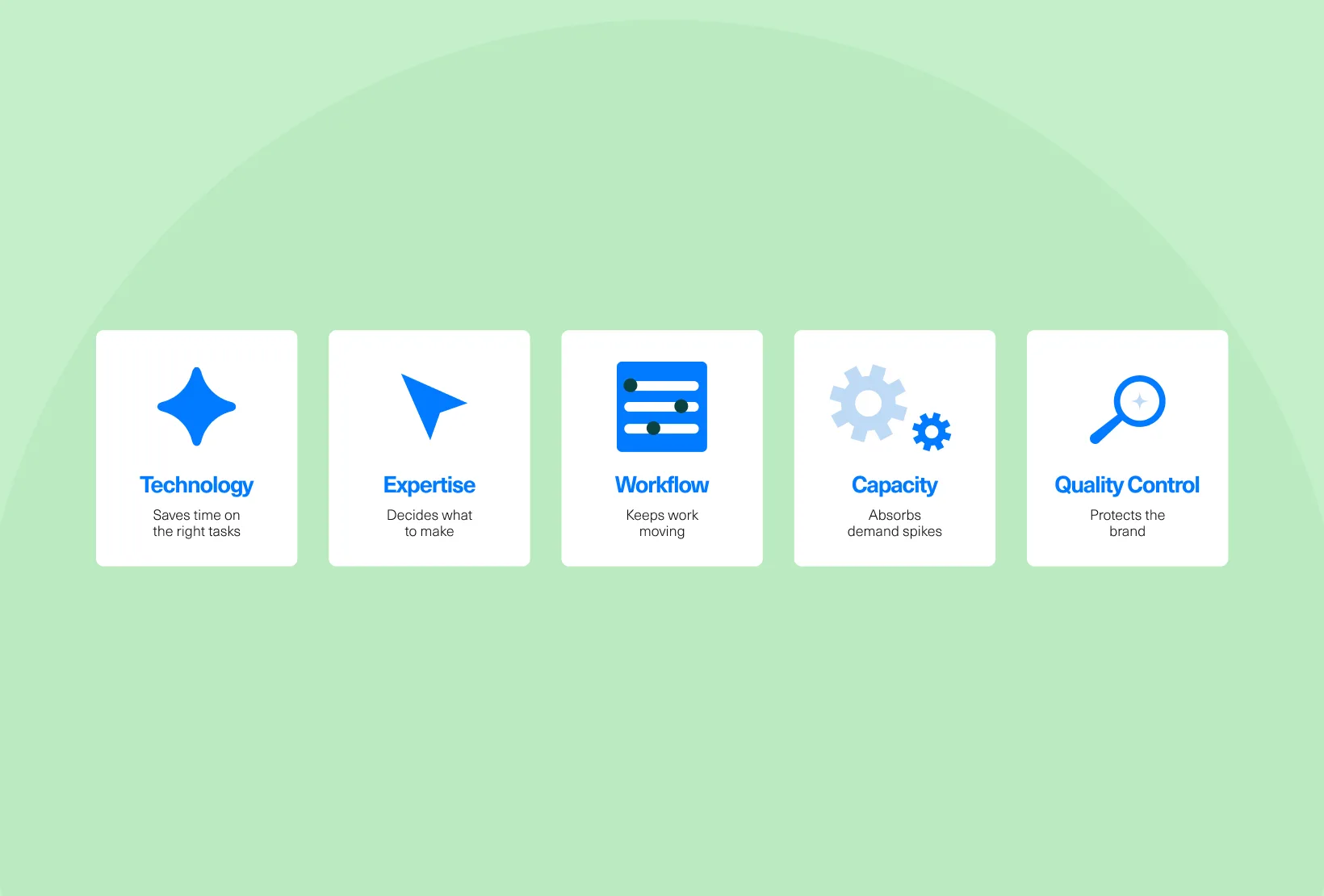
A tool that generates output nobody has the capacity to direct, refine, and approve has added work to the queue rather than removing it. That’s the mechanism behind most disappointing technology rollouts, and it’s a production design problem, not a tooling problem.
For Design Force, creative production runs as a managed system. A dedicated team holds the brand context across projects rather than rebuilding it each time; work moves in 48 to 72 hours (depending on the project’s complexity), and every asset passes through the same creative direction and quality standards regardless of how it was produced.
Where AI-powered creative fits a client’s brand guidelines and the project at hand, our team selects and directs the appropriate tools, then refines that output to the same standard as everything else we deliver.
The next creative advantage is production velocity
Creative work can start faster than ever. Whether the rest of the process can absorb that speed is still an open question in most organizations.
Teams measuring success by tools deployed, assets generated, or time saved at the start of the process are measuring inputs. The measures that show whether anything worked are:
- Production-ready output
- Campaign velocity
- Quality
- Brand consistency
- Capacity released back to strategic work
- Creative actually launched
Frequently asked questions
What is a creative production bottleneck?
A creative production bottleneck is a stage where work enters faster than a marketing or creative team can turn it into finished, approved assets. It can occur in briefing, production, reviews, approvals, adaptations, QA, or capacity, limiting how much creative reaches the market.
What causes creative bottlenecks in marketing teams?
Common causes include limited production capacity, unclear briefs, unnecessary handoffs, long approval chains, repetitive adaptation work, and quality or brand issues that cause rework. The backlog may appear to sit with design even when the underlying constraint is elsewhere in the workflow.
Why doesn’t hiring more designers fix a creative bottleneck?
New hires inherit the existing workflow, including the same approval chain and the same briefing process. If the constraint sits in reviews, coordination, or intake, additional capacity queues behind the same stage. Headcount can’t easily adjust when creative demand rises unexpectedly.
Can AI eliminate creative production bottlenecks?
AI can reduce bottlenecks in specific tasks, including concept exploration, image generation, retouching, and repetitive adaptation. It doesn’t automatically fix approvals, ownership, capacity, brand alignment, or QA. Those stages still need an effective production process.
How can marketing teams speed up creative production?
Audit where work waits before adding resources. Match the fix to the finding: shorten approval chains, standardize briefs, clarify ownership at each handoff, route repetitive production separately from strategic creative, and build scalable capacity by outsourcing the right partner.
How do you measure creative production efficiency?
Track turnaround time, assets completed, average revision rounds, revision origin, time from brief to final, handoffs per asset, approval latency, on-time launch rate, and the proportion of team time spent on production versus strategy.